
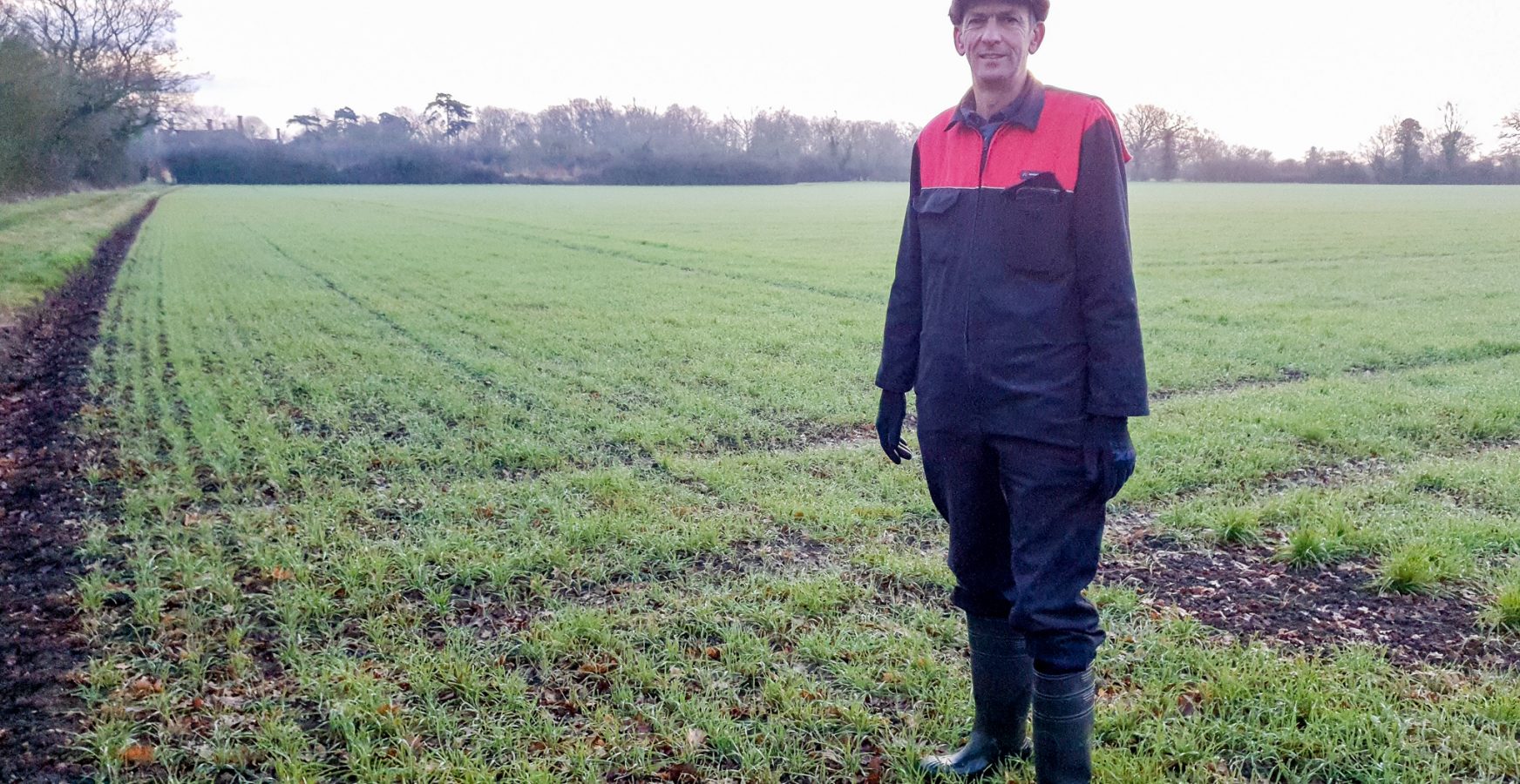
The Ling family have run Grange Farm in Otley since Anthony’s great grandfather moved here in 1885 and then bought it in 1900. Anthony started working on the farm in 1982, and, after marrying Vanessa, they brought up their family here. Their three children don’t currently have an interest in the farm, so Anthony and his father, Russell, manage this long narrow farm of 160 acres between them.

With 1600 chickens, 200 laying hens, 70 acres of wheat, 30 acres of barley and 20 acres of linseed, plus all the paddocks, hedges, farm tracks, buildings and machinery to maintain, this is not an easy way to make a living.
“Farming is a generational thing,” says Anthony. “And it’s not about the money, most farmers tend to be asset rich and cash poor, but it’s a way of life. Yes, that’s a cliché but it’s so true.”
Anthony’s family is inextricably linked to the land here. He points out a long hedgerow that he planted 25 years ago to celebrate his son’s birth, and trees commemorating his daughters coming into the world. At the furthest boundary, there is a wooden bench with a tree planted next to it.
“I love the whole farm,” Anthony says, “but I love that bit particularly. You sit here and you hardly notice any traffic noise, just the birds singing. It’s wonderful. My mum, Rita, liked it so much she asked for her ashes to be scattered here when she died nearly ten years ago. The bench and the American Red Oak commemorate her life. I know a lot of people love to come and just sit here. I do too.”

As we walk through the fields on this bright and crisply cold January morning, I ask Anthony how he sees the connection between farming and nature.
“I’d like to think that all farmers see themselves as guardians of nature on their land. Farming and nature go hand in hand. I know a lot of people blame farmers and agrochemicals, rather than roads, houses and industry, for habitat destruction and loss of wildlife, but we really do our best.”
Grange Farm has quite a lot of trees and hedges. Originally cut every one or two years, Anthony is intending to move to a regime of hedge cutting every two to three years, and this is rotated so there are always hedges on the farm which are bearing fruit for the birds to eat over winter.
“We also tend to flat-side them and leave the tops to grow, until they get too high, of course. And in addition, we try to leave a few saplings to grow up in the hedges. We did that in the fields running parallel to Helmingham Road. We also plant trees in hedges.”
As well as being good wind breaks, Anthony explains that hedges can be a real asset to any farm, especially when they have wide grass margins next to them.

“We’ve got quite a lot of wide margins along our fields and by having these we actually think we’ve built up a predator bank which protects our crops from the likes of aphids. I can’t remember the last time I sprayed our wheat with an aphicide. Aphids used to be a massive problem so we had no choice but to spray, but we think that working with nature in this way has meant we don’t have to resort to insecticides very often now. We’re thinking of increasing our margins to three or even six metres. Some farmers with large fields have predator strips or so-called beetle banks in the middle of their field to create a haven for predators to help with aphid reduction.”
About 25 years ago, Anthony ran an innovative self-financing scheme on the farm whereby he had a network of about 4.5 miles of grass trails around his fields which local horse riders could pay to access. This is how some of the grass margins came about. Sadly, over time, fewer and fewer riders used the trails, so the scheme stopped, but Anthony thought so much of the wide margins that they decided not to plough them up.
I wondered if public footpaths caused any problems to the farm, but Anthony says not. He did feel it was a shame about the ones running through the middle of field though as to maintain them he has to spray the paths and he’d rather not.
“But I would like it if people didn’t wiggle through the fields,” he says, laughing. “I mean, why can’t people walk straight?!”
And talking of crooked paths, another of Anthony’s ideas to streamline the work on Grange Farm at the same time as making way for nature is to square up his odd-shaped fields. He has one field with ten corners and says “that takes a lot of time and diesel to deal with.” His plan is to plant the awkward corners with either trees, grass or wildflowers. Yes, that means less land to grow crops on but it’s a question of balancing output and work and understanding that these ‘wild’ spots can be working hard for the crops in their own way.
Anthony very obviously loves the land he cares for. He talks of his favourite season, Spring, when his crops are just starting to grow and become green and lush, and the leaves on the hedges burst. This is before his busy time which begins in early June with the hay harvest. He remains more or less flat-out with work from then until the linseed is combined in early September and the autumn crops are planted by the end of October.
“Whenever I go on holiday, I always like coming back. There’s nowhere else I’d rather live. I consider myself blessed and very lucky to have what I have.”
I leave Anthony to start his work for the day. He has a spring in his step. I can’t help thinking that, while he feels lucky to live here, Grange Farm is equally lucky to have him as its current guardian.

As well as farming full time, Anthony Ling is the chairman of Otley Parish Council and also the Community Council.

